
Your Marketing Might Not Be the Problem
You’ve increased your visibility.
More people are finding your website. Your social presence is growing. Maybe referrals are sending people your way.
But those people aren’t consistently becoming customers.
It’s easy to assume the answer is more marketing.
More content.
More ads.
More traffic.
More reach.
But before you invest in getting more people to find your business, there’s another question worth asking:
What happens after they find you?
Because visibility creates an opportunity.
What happens next determines whether that opportunity keeps moving forward.
Your Customers Don’t See Channels. They See Your Business.
Businesses often manage their digital presence one piece at a time.
The website is one project.
SEO is another.
Social media has its own strategy.
Reviews get attention when someone remembers to ask for one.
Follow-up happens after an inquiry comes in.
Internally, those may feel like separate functions.
Your customer doesn’t experience them that way.
Someone might discover you through Google, check your reviews, visit your website, look at your social presence and then decide whether to contact you.
To them, that’s not five separate marketing channels.
It’s one experience with your business.
And at every step, they’re gathering information that helps them decide whether to keep moving forward.
That’s where a simple customer experience framework can help.
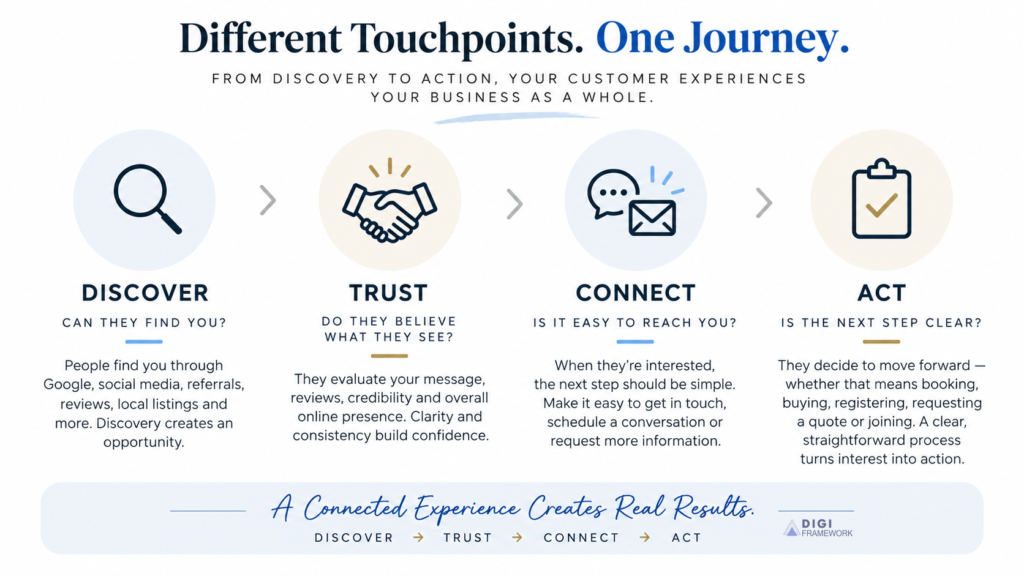
A Customer Experience Framework: Discover → Trust → Connect → Act
Think of the digital customer journey as four connected stages:
DISCOVER: Can they find you?
TRUST: Do they understand what you do and feel confident in what they see?
CONNECT: Is it easy to reach you when they’re ready?
ACT: Is the next step clear and easy to take?
Different touchpoints may influence each stage, but your customer experiences them as one journey.
Let’s look at what happens at each stage.
1. Discover: Can People Find You?
Discovery is the moment someone first encounters your business.
That could happen through:
- Google or another search engine
- Social media
- A referral
- Online reviews
- Local listings
- Content
- Word of mouth
Businesses understandably spend significant time and money here. Without discovery, the rest of the journey can’t begin.
But there’s an important distinction:
Discovery doesn’t create a customer. It creates an opportunity.
Once someone finds you, something else has to happen.
They have to decide whether you’re worth exploring further.
2. Trust: Do They Understand You and Believe What They See?
This is where the journey gets interesting.
Someone knows you exist.
Now they’re evaluating you.
They may be wondering:
What exactly does this business do?
Is this right for someone like me?
Do they seem credible?
What have other customers experienced?
Does what I’m seeing feel consistent?
Your website, messaging, reviews, social presence, content and overall professionalism can all influence those answers.
And there’s a difficult reality about this stage:
When someone loses confidence here, you may never know it happened.
There’s no abandoned inquiry to follow up on because they never submitted one.
They simply leave.
That’s why visibility by itself doesn’t tell you whether your digital presence is working.
People can find you and still decide not to continue.
3. Connect: Is It Easy to Reach You?
Now imagine that someone likes what they see.
They’re interested.
What happens next?
Can they easily find your phone number?
Does your contact form work well on mobile?
Can they schedule a conversation if that’s appropriate for your business?
If they call and nobody answers, what happens?
If they submit an inquiry, how long do they wait for a response?
This is where marketing begins intersecting with systems and customer experience.
A business can create excellent visibility and establish plenty of trust, then introduce unnecessary friction at the exact moment someone raises their hand.
Sometimes the problem isn’t generating the lead.
It’s what happens after the lead arrives.
4. Act: Is It Easy to Take the Next Step?
Interest isn’t the same as action.
Depending on the business, “Act” could mean:
Book. Buy. Schedule. Request a quote. Register. Join. Visit. Donate.
Whatever the desired action is, the customer should understand what happens next.
The process shouldn’t introduce unnecessary confusion at the moment they’re ready to move forward.
That’s why the Act stage isn’t simply about having a button that says Book Now or Contact Us.
It’s about creating enough clarity and confidence for someone to actually take that step.
More Visibility Can Amplify a Broken Journey
Here’s where businesses can easily misdiagnose the problem.
Suppose 1,000 additional people discover your business next month.
That sounds like success.
But what if your website doesn’t clearly explain what you do?
What if your reviews don’t support the reputation you’ve built offline?
What if someone calls while you’re busy and nothing happens afterward?
What if someone submits a form and waits three days for a response?
What if they’re ready to move forward but aren’t sure what they’re supposed to do next?
In those situations, getting found isn’t necessarily the primary problem.
More visibility may simply send more people into the same friction.
More visibility doesn’t automatically solve a customer experience problem. Sometimes it simply sends more people into the same friction.
That’s why the customer journey deserves attention too.
Look for the Gap Before You Add More Marketing
Before asking:
“How do we get more people to find us?”
Ask four questions instead:
DISCOVER: Can the right people find us?
TRUST: Once they do, do they understand us and feel confident in what they see?
CONNECT: When they’re interested, is it easy to reach us?
ACT: When they’re ready, is the next step clear?
Pay attention to the first place where your answer becomes uncertain.
That’s the gap worth investigating.
You may discover that you genuinely need greater visibility.
But you might also discover that the bigger opportunity is clearer messaging, stronger reviews, a better website experience, faster follow-up or a more connected process.
In other words:
Diagnose the gap before prescribing the solution.
Sometimes the answer will be SEO.
Sometimes it’s the website.
Sometimes it’s reviews.
Sometimes it’s follow-up.
Sometimes it’s a system that isn’t connected to the next one.
And sometimes the answer isn’t more technology at all.
The goal is to understand the problem first, then determine which solution actually makes sense.
What Should Technology Be Doing?
Technology has an important role in this customer journey, but it shouldn’t become the point of the experience.
It should help remove unnecessary friction.
A good system might make sure an inquiry receives a timely response.
Automation might help information move from one system to another.
AI might help answer common questions or support parts of the customer experience.
But not every interaction needs to be automated.
Some moments are valuable precisely because there’s a person on the other side.
The question isn’t:
“What can we automate?”
A better question is:
“Where can technology make this experience easier without taking away the relationship?”
That’s an important distinction for relationship-driven businesses.
Technology should support the experience, not become the experience.
The Goal Isn’t More Marketing. It’s Forward Movement.
A strong digital presence doesn’t simply attract attention.
It helps the right person continue moving.
From finding you…
to understanding you…
to trusting you…
to reaching out…
to taking the next step.
Discover → Trust → Connect → Act
Different touchpoints.
One customer experience.
So before deciding that your business needs more marketing, ask a different question:
Where might people be getting stuck after they find us?
That answer may tell you far more about what your business actually needs next.
Not Sure Where People May Be Getting Stuck?
Sometimes the best place to start isn’t with more marketing.
It’s with a clearer picture of what customers experience when they discover your business online.
Our Digital Presence Assessment looks across your online presence to help identify opportunities for greater clarity, confidence and connection.
Explore the Digital Presence Assessment → Link To Assessment Here